
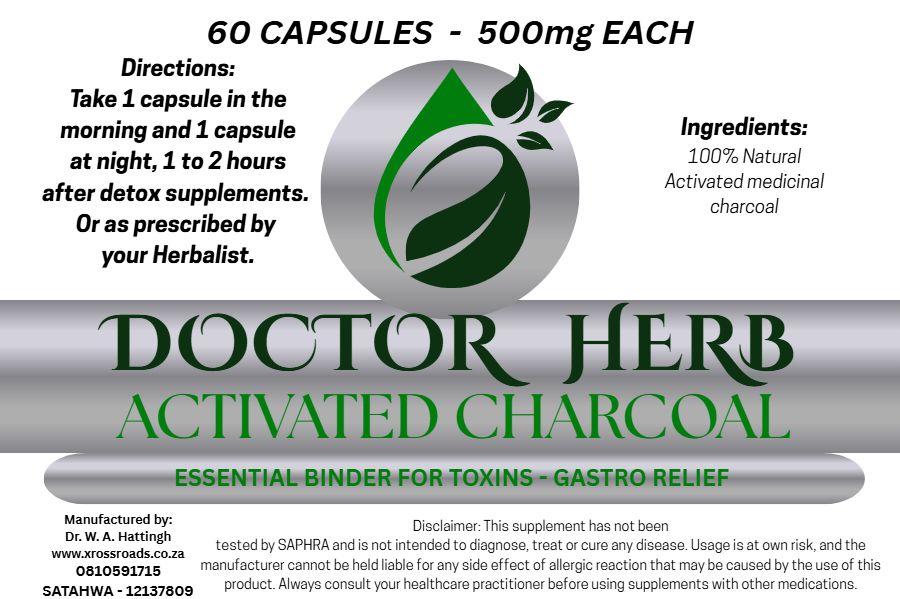
60 Capsules
Activated Charcoal (capsule and powder form)* for medicinal use
Medicinal Monograph: Activated Charcoal
1. Common English Name*Activated Charcoal
2. Scientific / Botanical Name
Not applicable — it is a *processed substance*, typically made from:
* Coconut shell
* Hardwood
* Peat
* Coal
Suggested labeling: *Activated Charcoal Powder/Capsules
3. What Is It?
Activated charcoal is carbon that has been “activated” — heated with gases to develop a very high surface area and many micro-pores. These pores *adsorb (bind)* molecules — especially toxins, gases, and chemicals — *preventing them from being absorbed* into the bloodstream in the gut.
> Adsorption is different from absorption: activated charcoal molecules stick to the surface of the charcoal rather than being absorbed into it.
4. Mechanism of Action (How It Works)
*Adsorption in the GI tract:* Charcoal binds toxins, gases, drugs, and other substances in the stomach and intestines.
* *Limits absorption:* Prevents bound substances from entering circulation.
* *Facilitates elimination:* The bound complexes are excreted in stool.
* Not absorbed: Activated charcoal stays in the digestive tract and is not taken up into the bloodstream.
5. Common Medicinal Uses
Activated charcoal is *primarily used for gastrointestinal adsorption* and detoxification.
A. Well-Established Uses
1. *Acute poisoning / overdose (emergency use)*
* In emergency medicine, given as soon as possible after ingestion of certain poisons/drugs.
* Most effective within *1–2 hours* of ingestion.
* Not effective for all toxins (e.g., alcohols, heavy metals like iron/lead).
2. *Gas and bloating (intestinal gas relief)*
* Can reduce gas and flatulence by binding gas-producing molecules in the gut.
3. *Traveler’s diarrhea / food poisons (adjunct use)*
* Sometimes used to reduce symptoms of acute mild diarrhea by binding irritants.
B. Commonly Used but Less Strongly Supported*
4. *General detoxification cleanses*
* Some use for “body detox” or removing environmental toxins — clinical evidence is limited.
5. *Kidney health (experimental)*
* Limited evidence that charcoal may reduce uremic toxins in chronic kidney disease, but not standard practice.
6. Dose & Administration
(Important: Always check with a clinician before use — especially for serious poisoning.)
Capsules
*Typical over-the-counter dose:*
500–1000 mg (1–2 capsules) 1–3 times daily for gas/bloating.
* For *acute poisoning*, much higher single doses are used under medical supervision.
*Powder Form*
*Typical medicinal dose:*
1–2 teaspoons mixed in water or juice, taken once or twice daily for gas/bloating.
* Powder form *can be used medicinally, but it can be harder to dose precisely and is **messier* to mix and consume.
7. Powder vs. Capsules: Key Differences*
| Feature | Capsules | Powder |
| ———————— | ——————– | —————————— |
| *Dosing precision* | ✔️ Easier | ⚠️ Requires estimating |
| *Taste, convenience* | ✔️ Tasteless | ❌ Chalky, gritty |
| *Mixing & consumption* | Easy | Less pleasant |
| *Versatility* | Limited to ingestion | Can be mixed, but same effects |
*Powder can be used medicinally*, and in emergency settings is often the form used (suspended in water). Capsules just offer convenience.
8. Safety & Side Effects
Activated charcoal is *generally considered safe* when used occasionally for gastrointestinal symptoms.
*Common mild effects:*
* Constipation
* Black stools (harmless but can alarm)
* Nausea
* Vomiting
*Serious risks (rare but important):*
*Aspiration* into lungs if taken incorrectly → can cause pneumonitis
*Interference with drug absorption:* May bind medications if taken near the same time
(e.g., thyroid meds, anticonvulsants, hormonal contraceptives)
*Safety tips:*
* Space at least *2 hours* between activated charcoal and other medications.
* Avoid if high risk for aspiration (e.g., unconscious, vomiting frequently) — especially without medical supervision.
* Not advised for children without clinician guidance.
9. Contraindications & Cautions
* Not appropriate for all poisons — e.g., heavy metals, strong acids or bases, alcohols (charcoal doesn’t bind well to these).
* Not used if *intestinal blockage* or *perforation* is suspected.
* Use with caution in pregnancy and breastfeeding — discuss with clinician.
10. Interactions
Activated charcoal can *bind many oral medications* and nutrients, reducing their effectiveness if taken too close together.
*Space dosing:* Take other medications *2–3 hours before or after* charcoal.
*11. Practical Tips for Use*
✅ For gas/bloating:
* Take charcoal capsules *after meals* with plenty of water.
* Consider only short-term use.
✅ For mild diarrhea:
* Start with lower doses to avoid constipation.
⚠️ For suspected poisoning:
* *Seek immediate medical care.*
* Do not self-treat serious poisoning at home.
—
12. References & Evidence Summary
* Activated charcoal is widely used in emergency medicine for poisonings (standard of care).
* Evidence for gas/bloating is supportive but less established than for poisonings.
* Detox uses are popular in herbal/natural circles, but clinical evidence is limited.
If you want, I can also provide a *quick dosage and contraindication chart* you can print or include in a manual.



Reviews
There are no reviews yet.